Last year in May, Ms Emily Chen, Chairman and Executive President of PCI Technology Group Co. Ltd. (PCITECH), joined the HKSAR Government delegation to the Middle East. From her perspective, this served as the “maiden voyage” for PCITECH’s global expansion, achieving a “dual alignment”: understanding the genuine needs of the Middle Eastern market, while simultaneously plugging into Hong Kong’s comprehensive support system as a “Super Connector”. Today, with the dedicated assistance of InvestHK and the city’s robust suite of business support policies, PCITECH has established its presence at the Hong Kong Science & Technology Parks Corporation (HKSTP). The company has initiated R&D and commercialisation efforts tailored for both the local and international markets. Looking ahead, leveraging Hong Kong’s unique strategic advantages, PCITECH aims to accelerate the deployment of its AI-driven smart transportation and urban governance solutions across the Middle East, Southeast Asia, and other international markets. In doing so, the company seeks to share its intelligent innovations with a wider international audience.
“The most significant takeaway from this journey was bridging the gap between ‘wanting to go to the Middle East’ and ‘knowing exactly how to get there and execute’,” Chen remarked, reflecting on her visit to Qatar and Kuwait with the government delegation. During the whirlwind multi-day tour, the PCITECH team held intensive meetings with government representatives, corporate giants and potential partners. This efficient face-to-face interaction allowed the company to swiftly clarify real-world demands, application scenarios, and implementation pathways for smart transportation and urban digitisation in the region.
Hong Kong’s role as a “Super Connector” was particularly prominent during this mission. Chen pointed out that Chinese Mainland tech firms often face a “language barrier” when expanding abroad — referring not to literal speech, but to the stark differences in compliance frameworks, data security regulations, technical standards, and business norms. By tapping into Hong Kong’s international connectivity and professional services, PCITECH’s cutting-edge technologies can be seamlessly “translated” into solutions that are practical, scalable and sustainable for international markets, thereby charting a clearer course for global expansion.
InvestHK Facilitates Landing at HKSTP
InvestHK played a pivotal role in the follow-up process. Following the Middle East mission, they moved swiftly to re-engage with PCITECH, efficiently facilitating connections with key resources such as the Hong Kong Stock Exchange (HKEX) and HKSTP. To date, PCITECH has completed its setup at HKSTP, securing office space and anchoring its international R&D operations within the city.
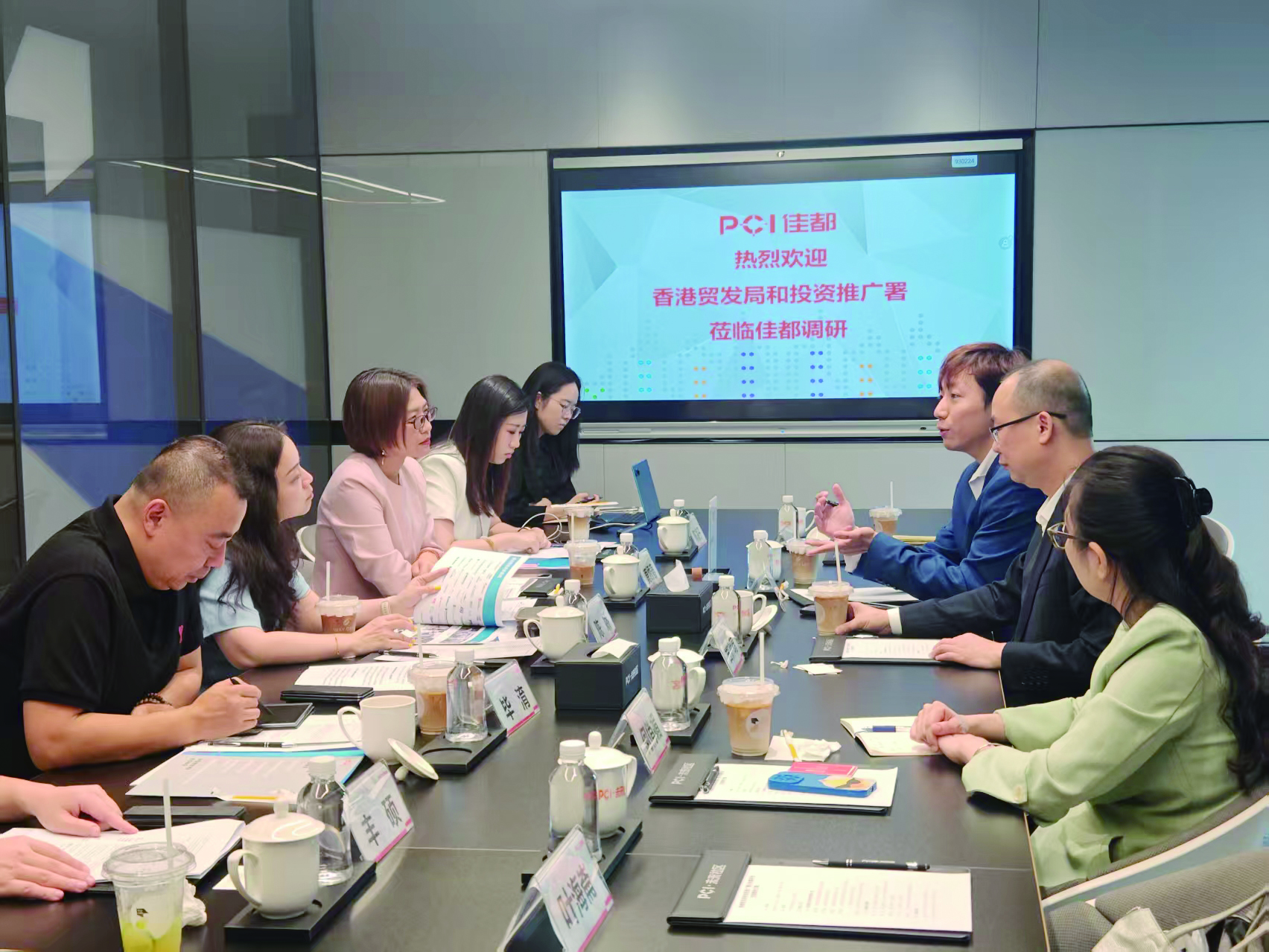
Following the business delegation to the Middle East last year, InvestHK and the HKTDC conducted reciprocal visits to PCITECH
Chen noted that the Hong Kong R&D centre will undertake two primary functions: first, to serve local clients by empowering the smart upgrade of Hong Kong’s urban infrastructure; and second, to spearhead the international adaptation of core products through customised development tailored to the needs of overseas customers.
Deepening Cooperation with Hong Kong Across Three Strategic Pillars
Regarding future deep-seated collaboration with Hong Kong, Chen outlined three strategic focus areas:
Establishing a “Scenario + Pilot” Mechanism: PCITECH hopes to collaborate with Hong Kong government departments, operators, and industry peers to transform real-world demands in smart transportation and urban governance into sustainable pilot schemes. This includes creating a long-term, open pilot list and evaluation mechanism — with clearly defined scenarios, metrics, and timelines — to enable enterprises to validate their technologies and achieve localised adaptation more rapidly in Hong Kong before adapting these proven solutions for the Greater Bay Area and international markets.
Creating an Industry Partner Matching Mechanism: With government support, the aim is to evolve one-off meetings into long-term operational networks. For example, led by InvestHK and involving HKSTP, research institutions, industry leaders, system integrators, financial institutions and professional service providers, this would form a regular framework for exchange, specialised matching, and joint innovation.
Overseas Market Linkage Mechanism: With clear expansion goals in emerging markets like the Middle East and Southeast Asia, PCITECH seeks to utilise Hong Kong’s international network to forge a more systematic “Go Global” model. This includes regular industry-themed delegations and market intelligence support, ensuring that projects — from initial negotiation to final landing — are more efficient and predictable.
Chen is highly optimistic about these foundations for cooperation. On the talent front, Hong Kong’s research institutions and universities offer deep expertise, particularly in AI, and attract a wealth of professionals from diverse international backgrounds, creating a strong pool that PCITECH is eager to tap into. Furthermore, the HKSAR Government’s commitment is evident through various funding schemes, which are instrumental in facilitating that crucial first step of collaboration.
Accelerating Product Internationalisation via R&D in Hong Kong
Since the Middle East mission, PCITECH has achieved significant breakthroughs in both technical development and industrial ecosystem building. Chen introduced the company’s “AI + OpenHarmony” dual-engine strategy. Last year, the company launched “TransHarmony”, the first OpenHarmony-based operating system for the transportation industry, driving device interconnection towards greater standardisation. Simultaneously, the “PCI Knowledge-Practice TransGPT” has evolved to version 3.0, with enhanced capabilities in comprehension, reasoning and learning.
Proven Implementation: Field Validation in Guangzhou and Shenzhen
“AI and OpenHarmony are a perfect match,” Chen explained. OpenHarmony provides the technical foundation for the Internet of Everything (IoE), serving as the fuel for the self-learning of AI large models. Currently, PCITECH is validating these technologies in cities like Guangzhou and Shenzhen, utilising AI traffic control agents to enhance transit efficiency.
On the industrial front, PCITECH is strategically enhancing the entire value chain of smart urban rail transit through targeted investments and collaborative synergies. Concurrently, the company is expanding opportunities for go-global partners in core technological domains. A prime example is the establishment of a joint venture for signalling systems in collaboration with Siemens Mobility and Guangzhou Industrial Investment Holdings Group (GIIHG) International Company Limited. This partnership represents a long-term commitment to joint R&D and integrated client services specifically focusing on advanced rail transit signalling solutions.
Looking ahead to 2026, Chen emphasised that achieving a “commercial closed-loop” will be the key priority. The company will leverage its Hong Kong R&D centre to accelerate the international adaptation of core products, while establishing Singapore as its regional marketing headquarters to build a smart city service network covering the Middle East and Southeast Asia.
04.05.2026
The purpose of the above content is to showcase companies which have set up or expanded in Hong Kong, with the assistance from InvestHK. It does not in any way constitute recommendation or endorsement by InvestHK.