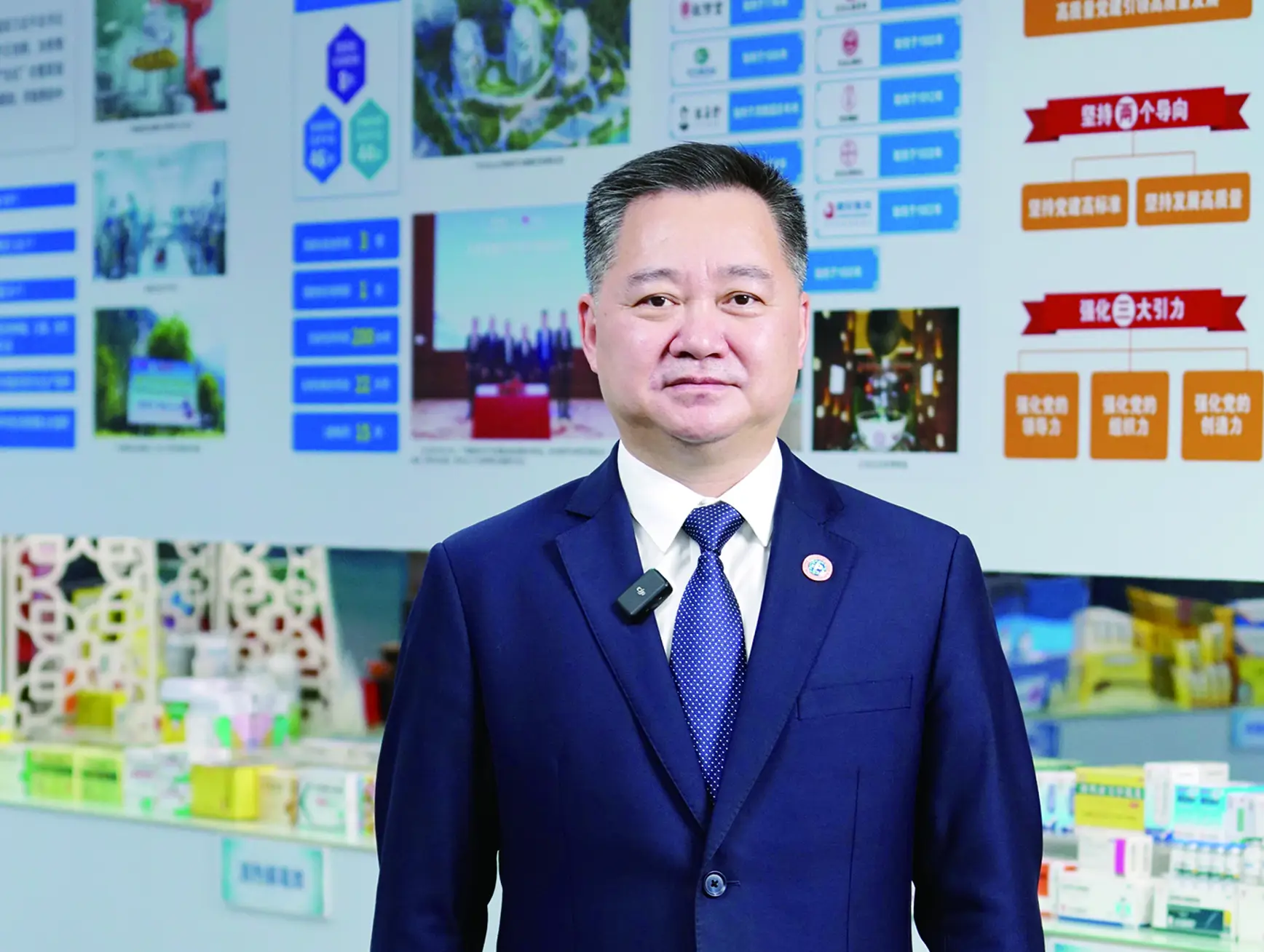
As the first Traditional Chinese Medicine-focused company to enter the Fortune Global 500, Guangzhou Pharmaceutical Holdings Limited (GPHL) has been accelerating its international expansion in recent years. The group has established both a treasury centre and an R&D centre in Hong Kong, and has initiated academic — industry — research collaborations with institutions including the Chinese University of Hong Kong’s School of Chinese Medicine, supporting the modernisation and globalisation of Traditional Chinese Medicine (TCM).
In an interview with Ta Kung Pao, Chairman Li Xiaojun said the group is stepping up investment in Hong Kong, leveraging the city’s “re-industrialisation” push to advance key projects and realise a strategic model of “R&D in Hong Kong, commercialisation in the Greater Bay Area, and global market reach.”
“As an international financial centre and a hub for biotech innovation, Hong Kong has always been a critical gateway for GPHL’s global visions,” Li said. “Since the establishment of Guangzhou Baiyunshan Pharmaceutical Holdings Co.,Ltd.International (Hong Kong) Treasury Centre and R&D Centre just over three months ago, progress has exceeded expectations. Together, they act as dual engines for our international strategy — one driving financial strength and operational support, the other enabling innovation breakthroughs.”
He noted that the treasury centre has completed initial team building and system set-up, while strengthening ties with long-standing financial partners such as Bank of China (Hong Kong). The R&D centre has also moved quickly, forming early-stage partnerships with the Chinese University of Hong Kong’s School of Chinese Medicine and Sun Yat-sen University’s Hong Kong Advanced Research Institute, fostering collaboration between local researchers, GPHL’s in-house scientists, and international experts.
“We’ve invested heavily in Hong Kong because of the lessons learned from years of global expansion,” Li explained. “From exporting products to building brands, and now to deploying a full industry chain overseas — we’ve taken a long, iterative path.”
He cited the example of herbal tea brand WALOVI, which has gradually built its international presence, from opening its first overseas flagship store in New York in 2018, to launching its English brand identity WALOVI, entering global retail chains such as Costco, and introducing internationally tailored product lines. “Behind this journey is the combined support of capital and continuous R&D innovation,” he added.
Hong Kong Treasury Centre to Manage Global Capital Flows
Li also pointed to GPHL’s pharmaceutical manufacturing facility in Macau, the first GMP-certified TCM plant in the city, as an example of leveraging regional advantages to access Portuguese-speaking markets. “Hong Kong and Macau are highly complementary. Hong Kong’s financial strengths, biotech R&D capabilities, robust IP protection, and seamless cross-border connectivity are all essential for global expansion.”
Looking ahead, the Hong Kong treasury centre will serve as GPHL’s offshore financial hub, enabling efficient global capital allocation and professional fund management. Meanwhile, the R&D centre will focus on TCM modernisation and innovative drug development, building a model of “Hong Kong-led research with global application” and acting as a key node connecting international research resources.
Li added that GPHL is also collaborating with the Hong Kong University of Science and Technology and the Hong Kong Productivity Council, alongside industry bodies such as the Hong Kong Biotechnology Organisation and the Chinese Prepared Medicine Traders Association.
The group has a mature model for external collaboration — such as partnerships between its subsidiary Guangzhou Baiyunshan Chenliji Pharmaceutical Factory, the University of Macau, and Guangdong Pharmaceutical University, will be replicated in Hong Kong.
He also highlighted Hong Kong’s “1+” drug approval mechanism introduced last year, a highly visionary policy breakthrough. It allows innovative drugs already approved in Chinese Mainland or overseas to be fast-tracked for registration in Hong Kong under certain conditions. “For us, this is effectively a fast track to global markets,” Li said, noting that the group is already leveraging the scheme to bring new drugs to market via Hong Kong as a stepping stone to international expansion.
“Looking ahead, GPHL’s strategy in Hong Kong will centre on full value chain integration — spanning innovation and R&D, industrial deployment, talent development, and global distribution,” said Li.
“By combining Hong Kong’s research strengths and international platform with GPHL’s industrial foundation, market channels, and clinical resources, alongside the policy advantages of the Greater Bay Area, we are well positioned to amplify ‘China’s expertise’ in the global pharmaceutical market and strengthen the international profile of the GPHL brand.”
He added, “We look forward to deepening collaboration with Hong Kong’s universities and research institutions, positioning the city as a key hub for connecting GPHL with global research resources. At the same time, we will actively explore Hong Kong’s international capital markets to mobilise broader investment through capital operations, supporting the global expansion of innovative drugs and high-end medical devices.”
Hong Kong’s International Standards Help Lower Compliance Costs for Global Expansion
“Engaging with Hong Kong has been a key priority since I took up my role at GPHL,” said Li Xiaojun. “For instance, I spent three days in the city last July, visiting Invest Hong Kong, Tseung Kwan O Industrial Estate, and the Hetao Hong Kong-Shenzhen Innovation and Technology Park — covering all of Hong Kong’s major biotech hubs.”
He noted that the most important takeaway from these visits was a clearer direction for the group’s international strategy: using Hong Kong as the pivot, localisation as the core approach, and cultural alignment as the bridge.
Li acknowledged that Hong Kong’s greatest advantage lies in its role as a “Super Connector” for Chinese Mainland companies expanding overseas. While it is a free port, it more importantly serves as a bridge between two systems and two cultures. Its common law framework, internationally recognised intellectual property protection regime, and highly transparent regulatory environment are particularly critical for the pharmaceutical industry.
He added that going global in the pharmaceutical sector is inherently complex, involving R&D, clinical trials, capital operations, and market access. Hong Kong’s GMP standards and the global recognition of its clinical data are closely aligned with international benchmarks. As a result, products from the Chinese Mainland that are validated through Hong Kong can significantly reduce compliance costs when entering markets in Southeast Asia, Europe, and the United States.
“Hong Kong connects China’s strong manufacturing capabilities and vast clinical data resources with leading global research institutions and well-established capital markets,” Li said.
He also highlighted that Hong Kong released its first Chinese Medicine Development Blueprint last December, reinforcing its role in primary healthcare and promoting the international adoption of TCM standards — demonstrating the full value of its position as a “Super Connector”.
Policy Support Accelerates Digital Transformation
Li described InvestHK and Hong Kong’s broader pro-business policies as a “dedicated partner” for companies expanding overseas. He pointed out the GoGlobal Task Force launched last October, which integrates government bodies and professional services to provide end-to-end support, from planning and market research to legal compliance, financing, and operational set-up.
“For pharmaceutical and biotech companies, where development cycles are long and capital-intensive, these policies can directly ease cash flow pressures and support digital transformation,” he said.
GPHL is currently undergoing a four-pronged transformation — modernisation, technological advancement, digitalisation, and internationalisation. “Hong Kong’s policy direction aligns closely with our strategy,” Li added. “It sends a strong signal that Hong Kong welcomes and supports enterprises looking to go global.”
30.05.2026
The purpose of the above content is to showcase companies which have set up or expanded in Hong Kong, with the assistance from InvestHK. It does not in any way constitute recommendation or endorsement by InvestHK.